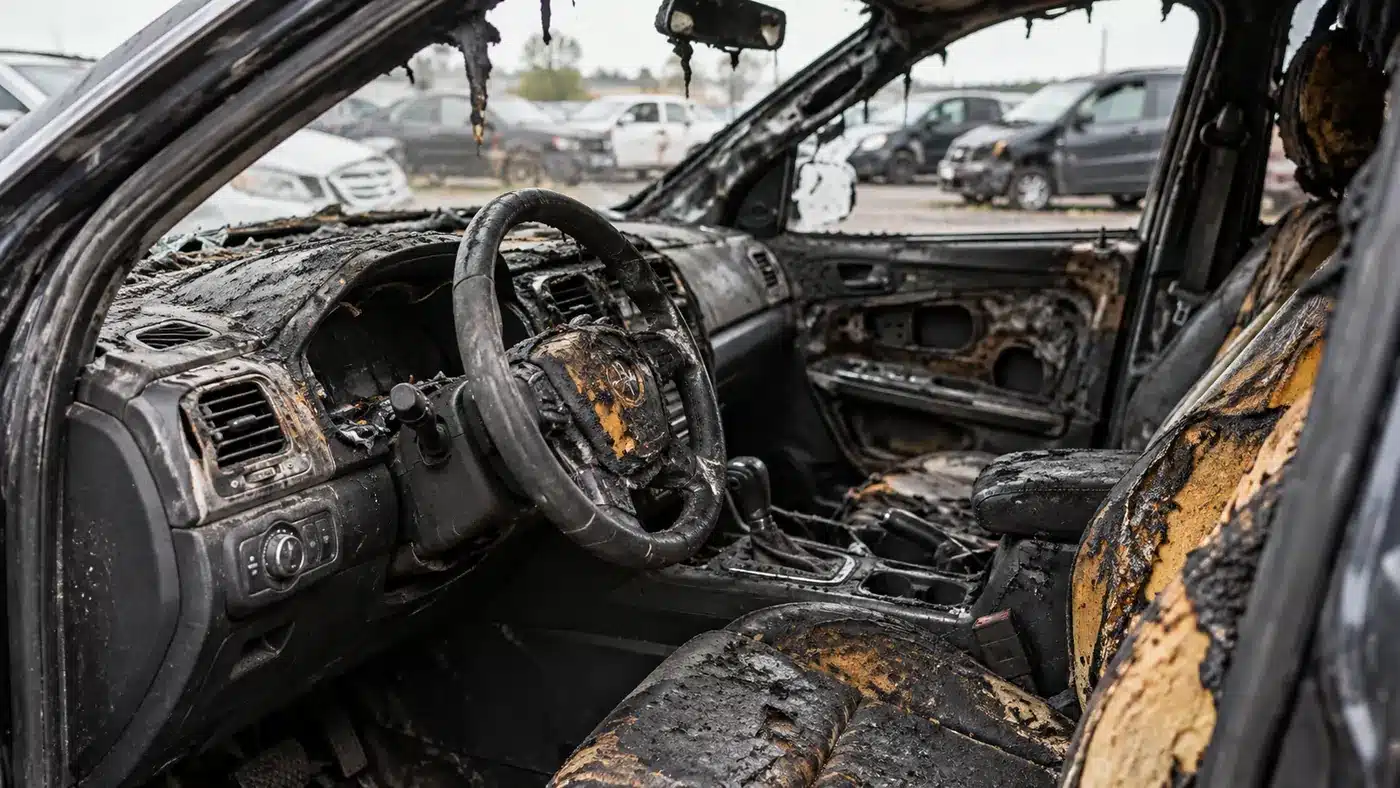
Yes, you can usually sell a fire-damaged car, and a burned vehicle often still holds recoverable value in its remaining parts and scrap metal. The important part is timing. Do not arrange collection until the scene is safe and any insurer or authority clearance relevant to the incident has been confirmed. Once that is settled, a fire damaged vehicle buyer can assess the wreck from photos and arrange pickup.
The extent of the burn changes everything: who can move the car, how it can be loaded, and what the offer looks like. The table below gives you a rough starting point for four common situations.
What to Confirm Before the Vehicle Is Released
A fire usually brings other parties into the picture. If you filed a claim, your insurer will assess the damage, and fire-damaged cars are often declared a total loss because the repair cost climbs quickly. That does not automatically stop you from selling the wreck, but it does mean ownership and settlement details must be clear before any money changes hands.
Ask your adjuster plainly whether the insurer is retaining the vehicle, whether a settlement has already been paid, and whether you are free to sell what remains. If you can get that answer in writing, even as a short email, keep it. Sellers who skip this step sometimes accept cash for a car that their insurer still has a claim on, which creates a mess that is far harder to unwind than a phone call.
If the fire is under investigation by a fire department or another authority, the vehicle may need to stay exactly where it is until it is released. Moving it early can complicate a claim or an investigation. Confirm release before you book any tow, and keep a record of who told you it was cleared.
Questions to ask your insurer
Has the vehicle been declared a total loss?
Will the insurer be taking possession of the vehicle?
Is a settlement still pending, or has it been paid?
Has the vehicle been released from any investigation?
Do you need anything from me before I arrange removal?
Ownership paperwork to have ready
The general rule that applies across most jurisdictions is straightforward: as the legal owner of a clear title, you can sell a vehicle that has been damaged by fire. In practice that means your registration and identification should be in order, and any lien or outstanding loan against the car needs to be dealt with, since a lender may have an interest in the vehicle. Confirm exactly which documents a buyer needs before pickup day so nothing stalls at the curb.
Photos and Details That Get a Faster, More Accurate Offer
A buyer can only price what they can see, and a fire wreck is unusually hard to judge from a single photo. Wide shots set the context, close shots show how far the heat travelled. Together they let a buyer give you a real number instead of a cautious guess that gets revised downward when the truck arrives.
The photo set to send
Four corner shots from roughly ten feet back, plus straight-on front and rear views
Close-ups of the burned area, including melted wiring, hoses, or trim
- One or two interior shots if the cabin was affected
- The VIN or compliance label if it is still readable
- A photo of where the car sits, showing the approach and any tight corners
Condition details worth mentioning
Along with the photos, write down a short list of facts that affect loading. Does the hood, trunk, or any door still open? Does the vehicle roll when pushed, or will it only move on a winch? Is there pooled fluid underneath? Is the battery still connected? Is any glass broken? Finally, describe the site itself, including low parkade clearance, gated access, a narrow lane, or soft ground that a loaded truck could sink into.
What Still Has Value in a Burned Car
A fire rarely destroys every component. Damage tends to concentrate in one zone, and parts well away from the heat can remain perfectly usable. Buyers who dismantle vehicles resell those parts individually, which is exactly why they can pay for a car that looks like a write-off in a photo. Even vehicles charred beyond repair may contain parts that are no longer in production and are difficult to source anywhere else.
Commonly recoverable items include drivetrain components, transmissions, doors, glass, wheels, and interior trim that escaped the heat. Parts exposed to extreme heat, and safety-critical components such as airbags and restraint systems, should be assessed by a professional rather than assumed to be serviceable. Scrap metal from the shell also carries value, which puts a floor under the offer even in the worst cases.
How burn extent changes the offer
Vehicle fire damage value comes down to spread and severity. A fire contained to one corner, such as a small engine-bay burn, usually leaves most of the car intact and therefore more valuable. A fire that reached the fuel system, the main wiring harness, or the cabin tends to affect far more of the vehicle. Structural distortion, a collapsed roof, and heavy smoke damage throughout the interior all reduce what remains reusable. The honest description you provide is what determines the number.
Why loading conditions affect the price
A car that rolls and steers can be moved onto a carrier with relatively little effort. A seized, collapsed, or immobile shell may need different equipment, more time, and extra care to avoid damaging the truck or the property. Buyers factor access into a quote, so telling them about a narrow driveway, an underground parkade, or a vehicle wedged against a wall helps them quote accurately the first time.
Before You Contact a Buyer: A Short Checklist
Work through this list and you will be ready to have a useful conversation rather than a series of back-and-forth messages.
Safety first. Keep people away from the shell until it has fully cooled and obvious hazards such as fluid leaks have been addressed. Do not handle melted wiring or damaged battery components.
Clearance. Confirm with your insurer, and with any investigating authority, that the vehicle can be moved.
Ownership. Make sure your paperwork is in order and any lien situation is resolved.
Condition notes. Write down what burned, what still opens, whether it rolls, and whether anything leaks.
Photos. Take the wide set and the close set described above.
Location. Note the exact address, where the car sits on the property, and anything that blocks the approach.
Pickup constraints. Mention low clearance, tight turns, gate codes, or soft ground up front.
Arranging Burned Car Removal and Pickup
Once clearance is confirmed, the process moves quickly. A fire damaged vehicle buyer reviews your photos, asks a few targeted questions, and makes an offer. If you accept, they handle the tow, and many buyers advertise free towing as part of the deal. For burned car removal, the operator needs to know the vehicle will not start, may not roll, and might still be leaking fluid, because that determines the equipment and the time required.
If you are in Metro Vancouver, BC Auto Recycling works with owners of burned, damaged, and non-running vehicles and handles the details of damaged vehicle buyer assessments by photo, so you get a number before anyone arrives. For vehicles inside the city, car removal can be arranged once the car has been released. To confirm clearance and request specialized pickup, have your make, model, year, location, known damage, and pickup constraints ready, and you can move from a burned-out wreck to a cleared driveway in a single conversation.
Frequently Asked Questions
Can you sell a car that has been in a fire?
Yes. As the legal owner of a clear title, you can sell a vehicle that has been damaged by fire, and buyers exist for everything from minor burns to a total loss. The one condition is clearance. If the car is part of an insurance claim or an investigation, confirm that it can be moved and sold before you accept any offer.
Do I need to tell a buyer the car was in a fire?
Always disclose it. The tow operator needs to know the vehicle may not roll, may not start, and could still be leaking fluid, because that affects how the car is loaded and how long the job takes. Hiding fire damage also leads to a revised quote on arrival, which wastes everyone's time.
How is a fire-damaged car valued?
Value depends on how far the heat spread, which parts remain reusable, the make and model, and demand for those components. Scrap metal in the shell sets a baseline. Because pricing depends on the specific vehicle, the reliable route is to send clear photos and condition notes and ask for a quote rather than estimating yourself.
Will my insurer let me keep the car after a fire?
It depends on your claim. Fire-damaged cars are often declared a total loss, and when a settlement is paid the insurer may take ownership of the vehicle. Ask your adjuster directly whether the insurer is retaining the car and whether you are free to sell it, and get the answer in writing before arranging pickup.
Can a burned car be towed if it does not roll?
Yes, but the operator needs to know in advance. A vehicle that will not roll requires a different approach than one that can be winched onto a carrier. Many buyers advertise free towing as part of the purchase, so mention the vehicle's condition and your site access when you request the quote.
Need an as-is quote? BC Auto Recycling buys cars in any condition across Metro Vancouver. Share the make, model, year, location, known damage, and pickup constraints to arrange a clear quote and collection.